26. 10. 26
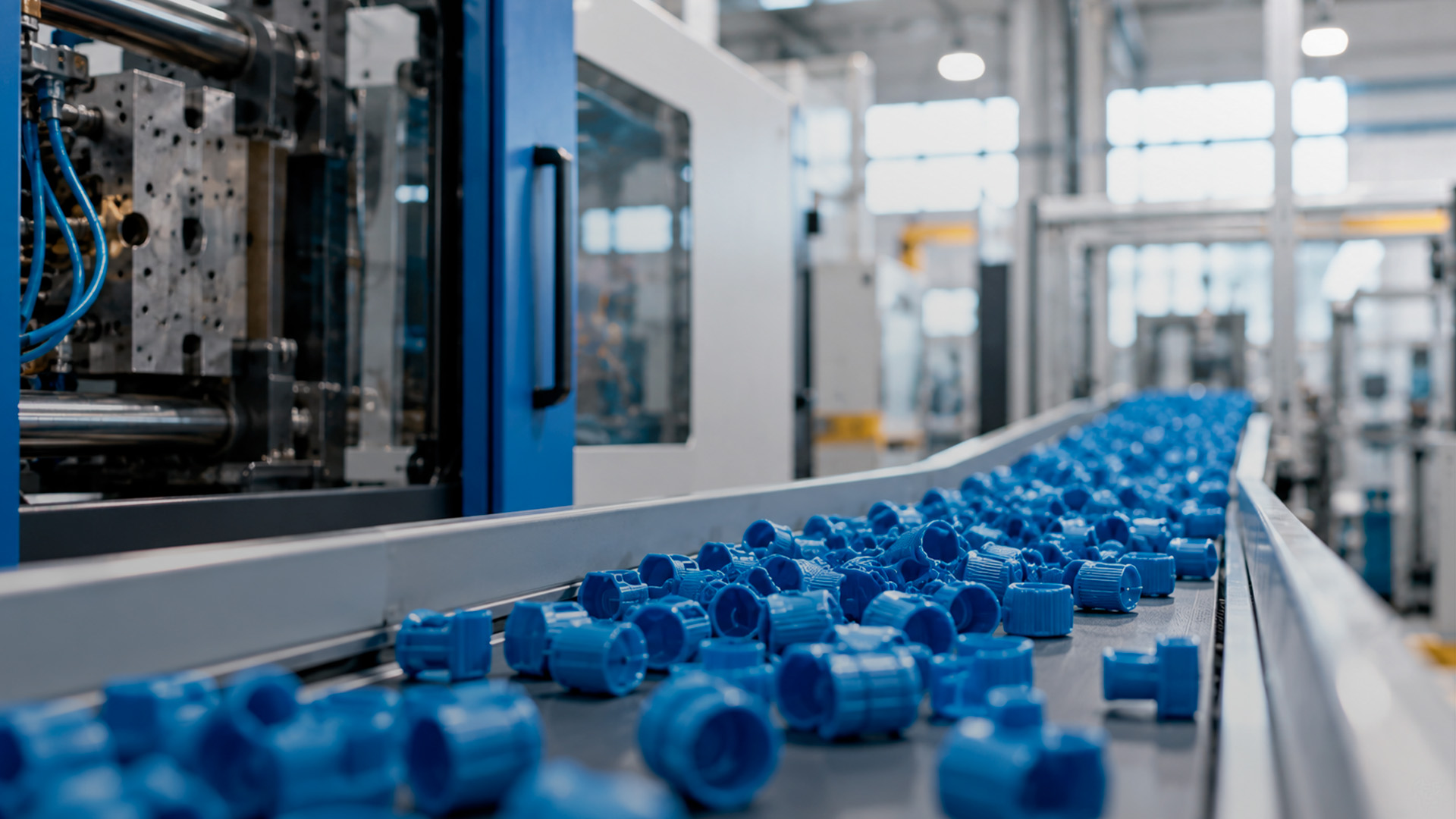
Productive efficiency in the plastic and injection molding industry often depends not only on the performance of the injection molding machines. Subsequent operations, such as part collection, transportation, and storage, require solutions capable of ensuring continuity and efficient process management.
We have just returned from the experience in Fakuma 2026, This event once again represented an important opportunity for professionals in the plastics processing industry to meet, and once again brought attention to the technologies and production needs of the sector.
Among the many considerations, it turned out to be crucial to consider what happens when a plastic component exits the press and to design the management of the operations following the molding process in a precise and specific way.
A fundamental part of handling, which can influence the efficiency of the entire production line.
Once the molding cycle is complete, the components must be collected, transported, and directed to the next production operations.
Depending on the characteristics of the product and the configuration of the system, different requirements may arise:
Collection of parts: the dimensions, geometries and characteristics of the components influence the methods of collection and handling.
Operational continuity: accumulations, uncoordinated transfers, and manual interventions can slow down subsequent operations.
Space management: the arrangement of presses and other machinery determines the path of the components within the plant.
Filling and storage: the management of containers must be organized according to volumes and production rhythms.
How can these needs be addressed? Starting with the design of a handling flow that is consistent with the characteristics of the entire process and the production facility within which it operates.
It is not always possible to predict a linear path between the press and the subsequent operations.
The arrangement of the machinery, the dimensions and the connectivity requirements between different areas may require specific configurations.
In these cases, the choice of conveyor belt becomes an important element for optimizing the flow of components and taking advantage of the available space.
An example is the M2810 curved conveyor belt from Crizaf, Designed with a reduced radius of curvature compared to traditional curvilinear belts, to allow the transport of components even in confined spaces.
The steel structure, the modular carpet and the traction system with gear wheels contribute to the robustness and reliability of the system; at the same time, the reducer with friction offers mechanical protection in the presence of obstacles that could compromise the operation of the carpet. A solution that demonstrates how handling does not have to be limited to simply transferring the parts, but can be designed according to the characteristics of the system!
Transport is only one of the operations that follow the molding process.
Once assembled, the plastic components must be collected and organized for the subsequent stages and the treatments to which they are destined.
Often underestimated, the filling of containers (which we can define as “storage”) can actually prove to be a critical operation, especially in the presence of continuous production cycles and high volumes.
To meet this need, Crizaf offers systems such as F3300, Designed to automate the filling of boxes through counting the pieces and interaction with the loading belt and the press.
An integration that allows the collection of components to be organized according to production rhythms, reducing the need for manual interventions and facilitating a more regular and continuous management of the process.
The dimensions of the components, the characteristics of the molds, the arrangement of the presses, the available spaces, and the collection methods are variables that significantly influence the configuration of a handling system.
Crizaf’s perspective is not simply to market systems capable of transporting a piece from one point to another, but organizing the path of the components within the production cycle, facilitating the connection between the different operations.
This is the reason why we develop Customized solutions for transportation, handling and storage of components, configurable according to the characteristics of each application.
Contact us to identify the configuration that best suits your system's needs!

P.I. 00855480125 | Cap. Soc. € 1,560,000 i.v. | VARESE Business Register | Tax Code 05970930151 | VARESE R.E.A. no. 184602